AMC / practice ready.
138 sourced study notes, 5,520 spaced-repetition flashcards and a 188-station OSCE simulator across the six AMC blueprint patient groups. MCQ CAT practice and Ask PRIMEX with Australian clinical reasoning throughout. Built for IMGs sitting Part 1 and Part 2.
Topics tested in the AMC exam
How candidates prepare for the AMC
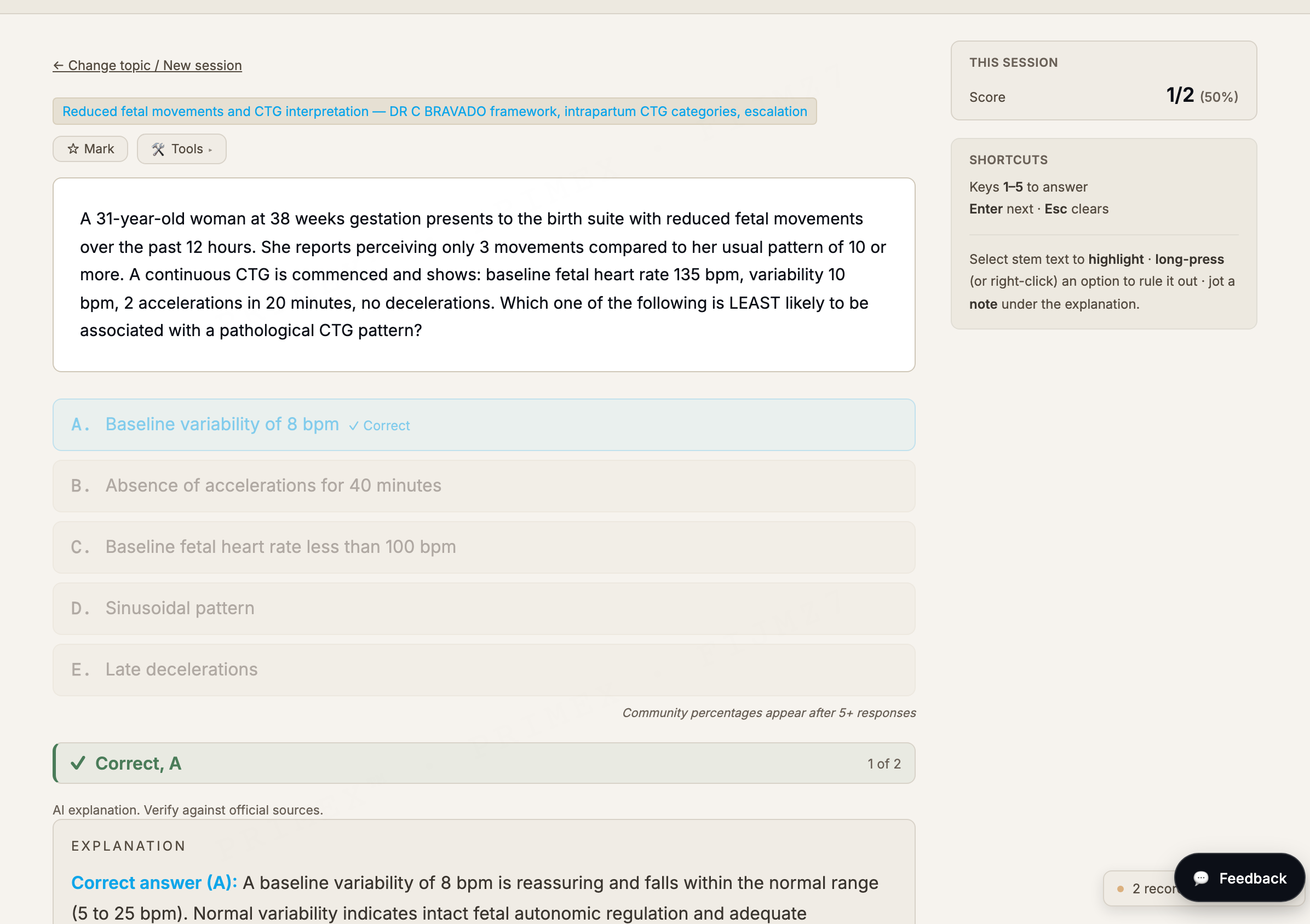
The AMC Part 1 is a computer-adaptive test of 150 questions (130 scored + 20 unscored pilot) across six blueprint patient groups. PRIMEX grades practice attempts and explains every option (correct and distractors) with Australian clinical reasoning: eTG antibiotics, PBS drug names, Medicare and NDIS referral pathways, mandatory reporting obligations.
- AMC-style MCQ library weighted to the six blueprint patient groups (Medicine 30%, Surgery 20%, Women's 12.5%, Child 12.5%, Mental Health 12.5%, Pop Health & Ethics 12.5%)
- Australian context throughout: eTG dosing, PBS drug names, Medicare, NDIS, ACAT
- Every option explained, not just the answer key
- Track per-topic accuracy and surface weak areas in the study plan
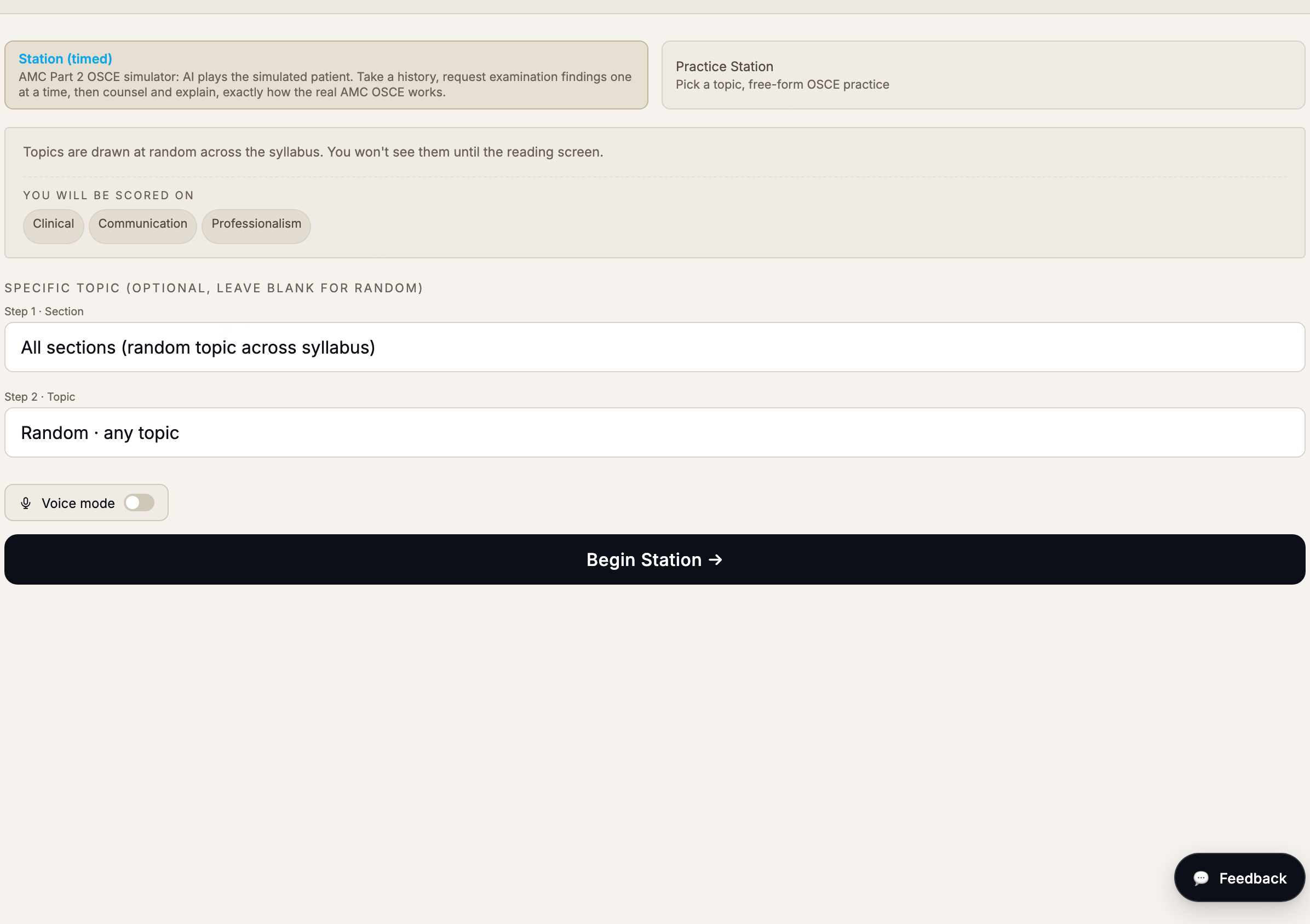
The AMC Part 2 Clinical OSCE runs 14 scored stations plus 2 unscored pilot stations and 4 rest stations at 10 minutes each (2 minutes reading + 8 minutes task), delivered in-person at multiple Australian centres and online via Zoom (current centres and fees on amc.org.au). PRIMEX simulates every station type with Australian clinical context and probes cultural safety, mandatory reporting, and Indigenous Australian health where relevant.
- 188 station scenarios across the five AMC OSCE task types: history, examination, explanation, procedural, ethics/communication
- Australian context mandatory: drug names are PBS, guidelines are eTG/RACGP, settings are Australian
- Examiner probes like "The patient is Aboriginal; any additional considerations?" and "What are your mandatory reporting obligations?"
- 2-minute reading + 8-minute task timing replicated, with structured feedback at the end of each station
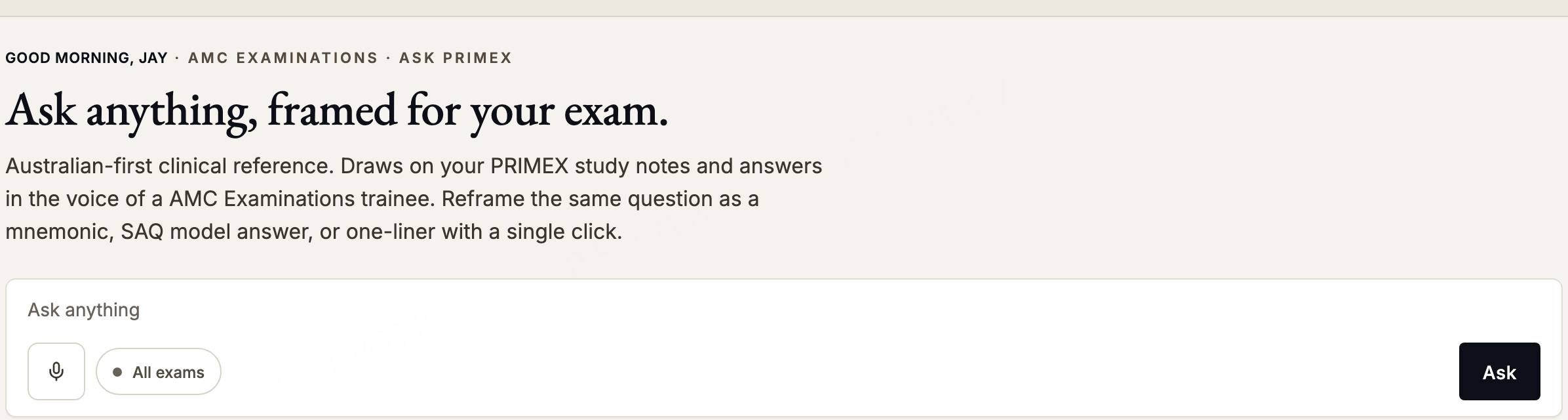
Most IMGs aren't unsure about the clinical medicine; they're unsure how Australian practice differs from where they trained. Ask PRIMEX is a chat tool framed for the AMC: ask anything about Australian drug names, eTG protocols, Medicare and PBS pathways, mandatory reporting obligations, the Mental Health Act, Austroads driving rules, or cultural safety, and get an intern-level Australian answer with the reasoning shown. Works on the phone between shifts.
- Answers framed for the AMC blueprint and Australian clinical context, not generic medicine
- Reframe modes: full answer, one-liner for quick recall, SAQ-style structured response, mnemonic, or compare two diagnoses
- Voice mode for hands-free use on a phone between ward shifts or on the commute
- Links each answer back to the relevant PRIMEX AMC notes so you can drill deeper
- Common IMG questions covered: "What does an MHCP actually pay for?", "What's the difference between eTG and BNF for community-acquired pneumonia?", "When is mandatory reporting triggered for child neglect in NSW?"
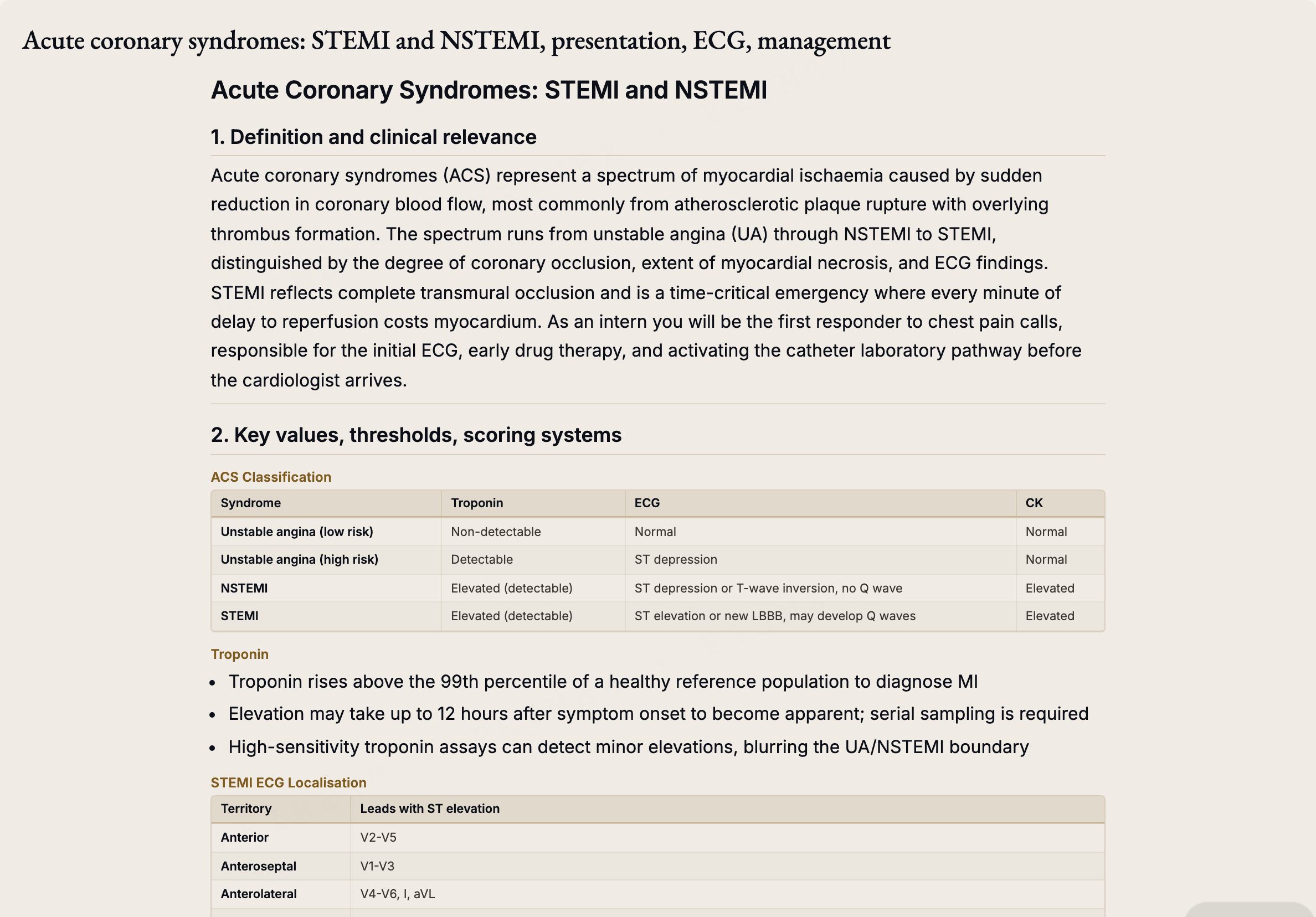
AMC study notes covering all six blueprint patient groups at intern level: eTG-aligned management, PBS drug names, Australian referral pathways, and the mandatory-reporting obligations AMC examiners specifically test. Designed so an IMG can read one note, then sit a station on the same topic the same day.
- 138 notes spanning the full AMC blueprint (Adult Medicine, Surgery, Women's, Child, Mental Health, Population Health & Ethics)
- eTG-aligned management protocols and PBS drug names throughout
- Australian systems explained explicitly: Medicare, PBS, NDIS, ACAT, MBS, bulk-billing, after-hours services
- Mandatory reporting sections: child protection, Austroads fitness-to-drive, notifiable diseases, elder abuse
- Indigenous health framing where relevant: SEWB, 715 health assessment, cultural safety
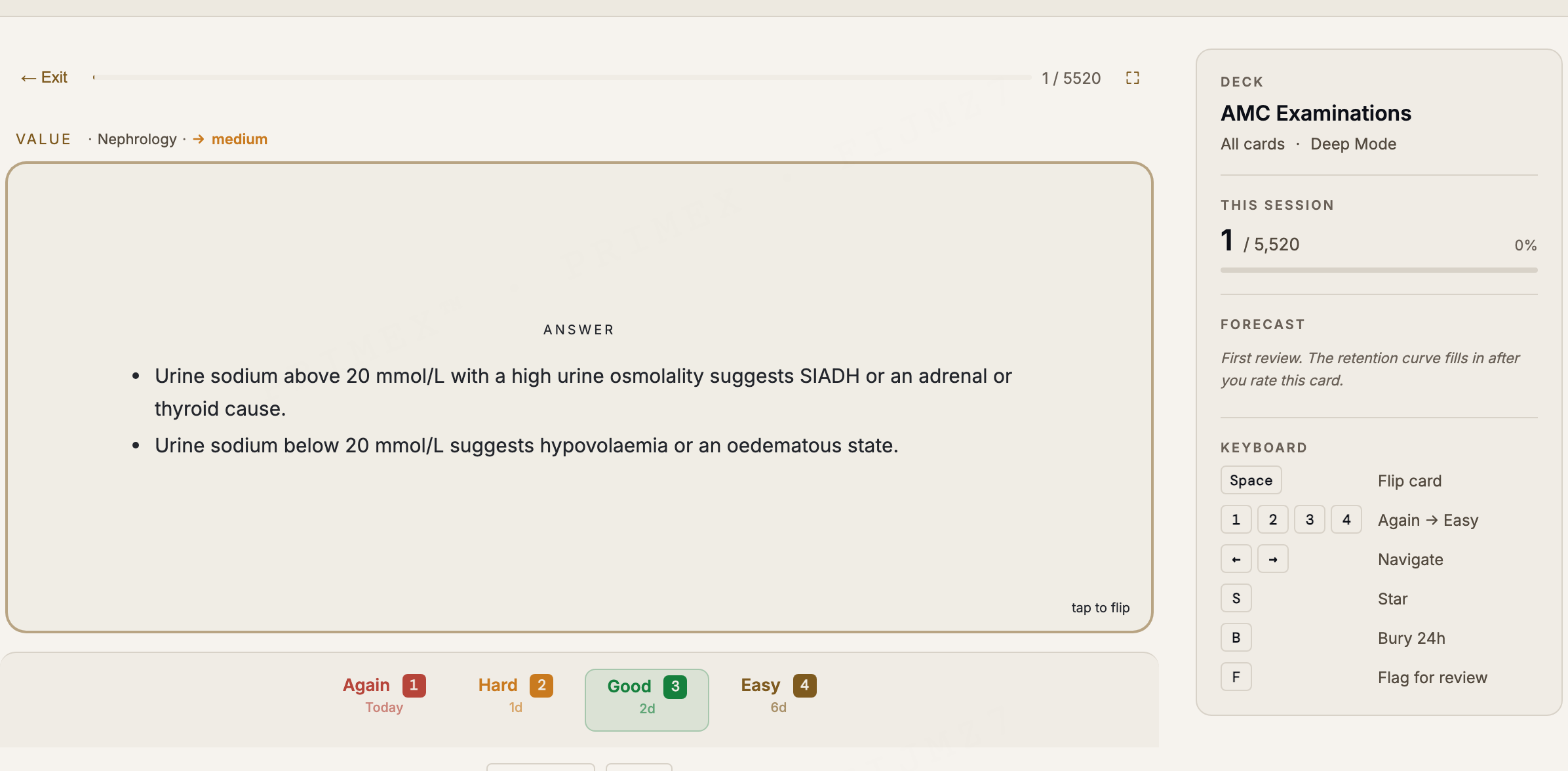
Forty cards per topic across all 138 AMC topics, scheduled with spaced repetition so you only review what you're about to forget. Card content is Australian-specific where it matters: PBS names, eTG dosing, MBS item numbers, mandatory reporting thresholds.
- 5,520 cards (40 × 138 topics), covering every blueprint patient group
- Australian-specific cards: PBS names, eTG dosing, MBS item numbers, NIP schedule
- Mandatory reporting cards: Austroads, notifiable diseases, child protection, elder abuse
- OSCE communication cards: SPIKES, ICE, MSE structure, consent elements
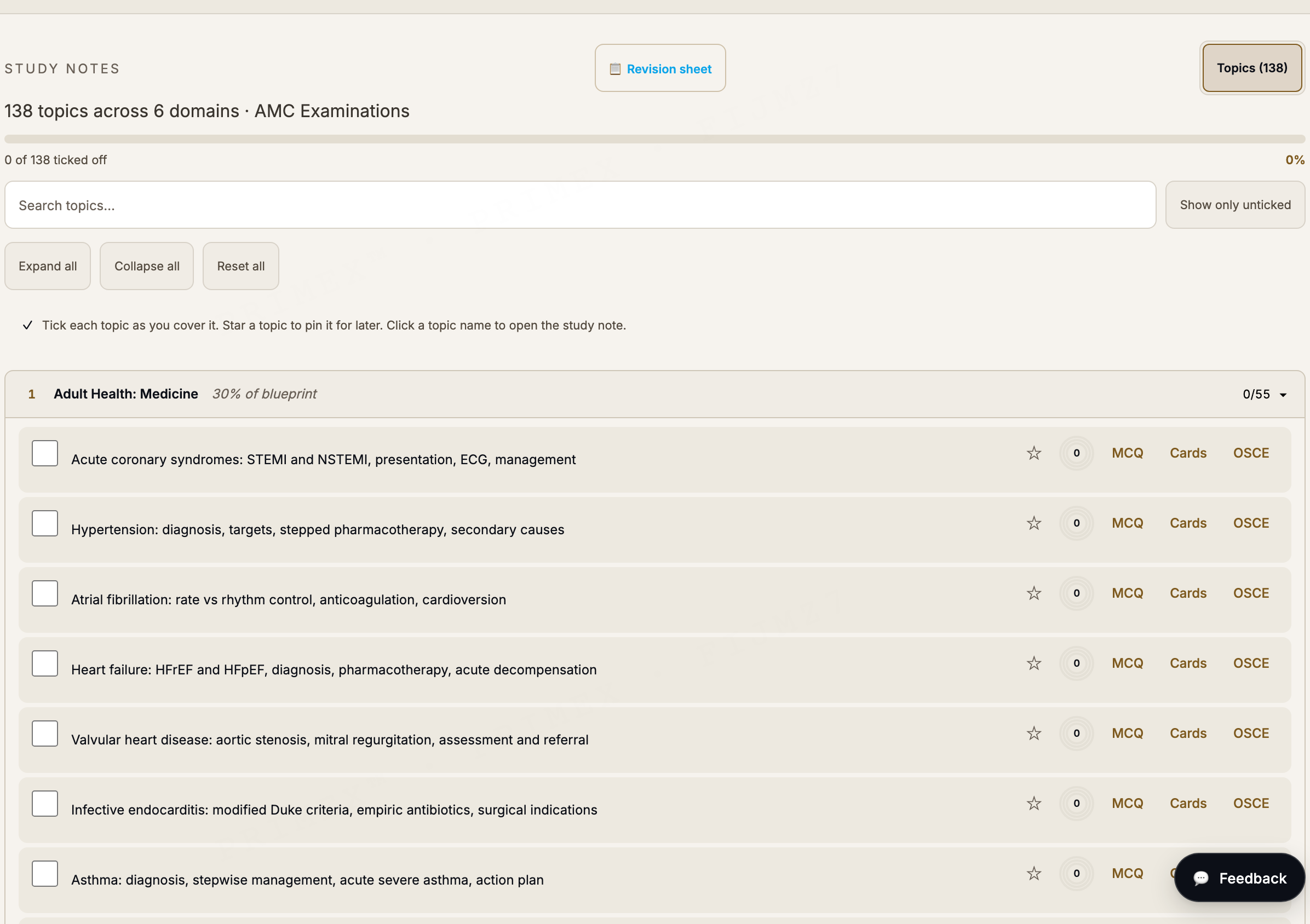
The AMC Examination Specifications (Edition 10, 2011) define 61 learning objectives across 9 sections (12 Knowledge & Understanding, 13 Skills, 15 Professional Attitudes plus systems and regions). PRIMEX organises those objectives into 138 study topics under the six blueprint patient groups and paces you through them with a daily plan you can finish in under an hour.
- 138 topics mapped under the six AMC blueprint patient groups, organised by domain
- Daily study plan with today's focus, this-week summary, and a streak counter
- Per-group progress tracking across notes, flashcards, MCQ and OSCE practice
- Communication learning objectives (AMC_SK_20, AMC_SK_22) linked to OSCE station types
- Cultural safety learning objective (AMC_KU_11) prominently tracked with linked Indigenous health content
AMC format and structure: AMC MCQ Part 1 and Clinical Part 2
The AMC Examinations are the pathway for international medical graduates (IMGs) seeking medical registration in Australia. The Part 1 AMC MCQ Examination is a computer-adaptive test (CAT) of 150 questions (130 scored + 20 unscored pilot) covering the six AMC blueprint patient groups. The Part 2 AMC Clinical Examination is an OSCE delivered in-person at multiple Australian centres and online via Zoom (current centres and fees on amc.org.au).
The OSCE consists of 14 scored stations plus 2 unscored pilot stations and 4 rest stations, each 10 minutes (2 minutes reading time + 8 minutes task), with a pass standard of 9 of 14 scored stations. The standard assessed is intern-level competency; the ability to function safely as a first-year Australian intern. All clinical content, drug names, guidelines, and systems must be Australian. The exam explicitly tests cultural safety and Indigenous Australian health. PRIMEX is built by Dr Jay Marshall, an anaesthetics registrar in Taree, NSW.
- OrganiserAustralian Medical Council (AMC), Canberra
- Part 1 MCQ CAT150 questions (130 scored + 20 unscored pilot), computer-adaptive, six blueprint patient groups, year-round sittings
- Part 2 OSCE14 scored + 2 unscored pilot + 4 rest, 10 min each (2 min reading + 8 min task), pass 9/14, in-person + online (Zoom)
- BlueprintAdult Medicine 30%, Surgery 20%, Women's 12.5%, Child 12.5%, Mental Health 12.5%, Population Health & Ethics 12.5%
- StandardIntern-level competency; safe practice as first-year Australian intern
- RegistrationSuccessful completion required for general registration pathway (with AMC pathway) and provisional registration
Try the AMC MCQ grader on five real topics
Five high-yield AMC blueprint topics. Each note has 3 exam-style MCQs with full explanations of every option, Australian clinical reasoning throughout. No signup needed.
Australian childhood vaccination schedule (NIP)
The National Immunisation Program (NIP) is a federally funded schedule providing free vaccines to all eligible Australian children from birth through adolescence.
Inflammatory bowel disease: Crohn's vs ulcerative colitis
IBD encompasses two distinct chronic relapsing-remitting conditions: Crohn's disease and ulcerative colitis. Features, distinguishing investigations and Australian treatment.
Hypertension: diagnosis, targets, stepped pharmacotherapy
Sustained elevation of blood pressure above accepted thresholds, confirmed on repeated measurement. Australian thresholds, targets and secondary-cause workup.
Cardiovascular risk assessment (absolute risk)
Absolute CVD risk is the probability of a fatal or non-fatal cardiovascular event over a defined period. Australian risk tool, lipid targets and statin thresholds.
Rheumatoid arthritis: features, serology, DMARDs
Chronic immune-mediated inflammatory arthritis characterised by synovial proliferation, progressive joint destruction and extra-articular manifestations.
Liked those five? That's a sliver of what's inside.
Unlock 138 study notes, 5,520 spaced-repetition flashcards, unlimited question practice and the full exam simulator. Free for 7 days, then from $15/month.
Start free trial, 7 days free Cancel anytime · no commitmentCommon questions about the AMC exam
Pricing and 7-day free trial
Library, study notes, voice viva, OSCE simulator and image-stem practice, all included on every plan. No locked tiers, no per-feature paywalls.
- ✓ All 21 exams: SAQ, MCQ, Viva & Voice
- ✓ Flashcards with spaced repetition & MCQ drill
- ✓ Study notes for every curriculum topic
- ✓ SAQ library & sessions
- ✓ Study plan with pace tracking
- ✓ Community feed
- ✓ All 21 exams: SAQ, MCQ, Viva & Voice
- ✓ Flashcards with spaced repetition & MCQ drill
- ✓ Study notes for every curriculum topic
- ✓ SAQ library & sessions
- ✓ Study plan with pace tracking
- ✓ Community feed
- ✓ All 21 exams: SAQ, MCQ, Viva & Voice
- ✓ Flashcards with spaced repetition & MCQ drill
- ✓ Study notes for every curriculum topic
- ✓ SAQ library & sessions
- ✓ Study plan with pace tracking
- ✓ Community feed
You'll land on a confirmation page. Tap the sign-up button (or sign in if you already have an account) and your subscription links automatically. If you close the page first, just use the same email when you sign up and it'll still link.